

One set you can finish
Choose from six suggested levels, from 800 to 2000+, with fixed sets of 100 to 400 puzzles.
Work through the same puzzle set in cycles. Practice tactical patterns and track your pace.
Independent ChessFlare training experience inspired by the Woodpecker Method. No affiliation and no book exercises reproduced.
Finish late if necessary. A careful cycle is more useful than a rushed deadline.
Choose a set, make one official attempt, review the result, and follow progress through six core cycles and a conditional seventh.
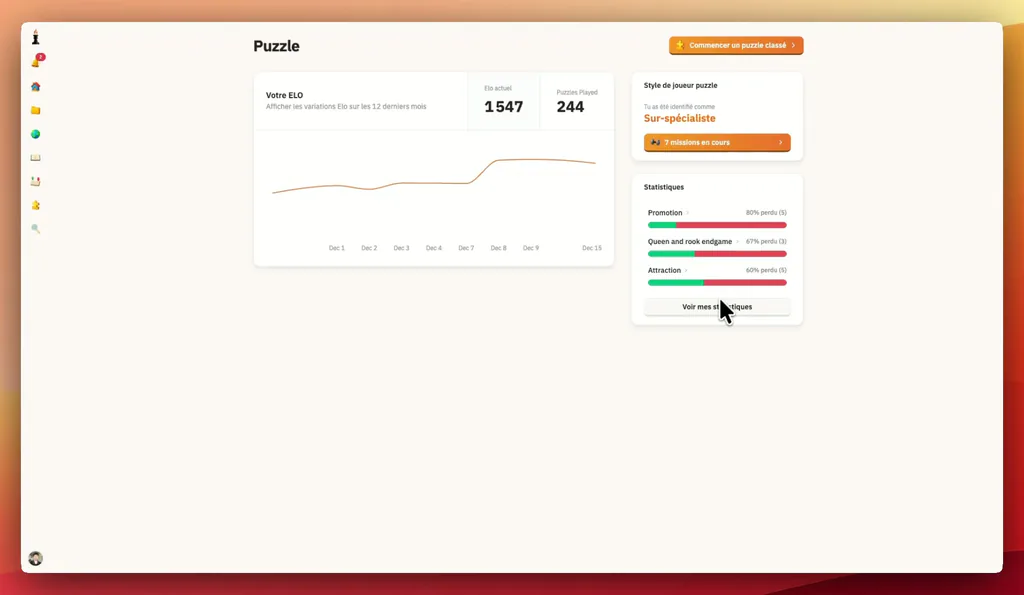
This preview shows the shared ChessFlare tactics workspace. A Woodpecker-specific walkthrough will replace it before publication.
An endless feed is useful when you want new positions. Because the set keeps changing, however, it is difficult to separate genuine improvement from puzzle difficulty, theme, or luck. A fixed set creates a stable benchmark between cycles.
The goal is not to memorize moves mechanically. It is to recognize tactical cues sooner while keeping the calculation accurate.
Test fixed-set progress later with mixed puzzles and real games.
The training stays finite, honest, and focused on the relationship between precision and pace.
Choose from six suggested levels, from 800 to 2000+, with fixed sets of 100 to 400 puzzles.
Start with a general set, or choose one of ten thematic families when you already know the pattern to repair.
A hint, failed line, or abandonment remains incorrect, so a corrected second look cannot inflate the cycle.
Track accuracy, active solving time, median time, puzzles per minute, and changes between cycles.
Your active program is saved, so you can stop when attention drops and resume later.
Complete the entire set before moving forward. Suggested windows help pace the work; they are guides, never deadlines. If cycle six is completed within 24 hours, the program ends there; otherwise a final one-day cycle is offered.
Take time to calculate and review every miss.
Recover the tactical idea before chasing pace.
Keep the line accurate while decisions become cleaner.
Notice familiar tactical signals before calculation expands.
Stay controlled while the repeated set feels familiar.
Use familiarity without turning the session into guessing.
Offered when cycle six takes more than 24 hours; otherwise the program ends after cycle six.
Finish late if necessary. A careful cycle is more useful than a rushed deadline.
The set stays fixed for the whole program. Choose the type that matches the question you need training to answer.
Use a general set for mixed tactical decisions or when you do not yet know which motif causes your mistakes.
Use a themed set when your games repeatedly reveal one tactical family. Ten theme families are available across six difficulty levels.
ChessFlare separates active solving, pauses, and analysis so cycle time stays interpretable. It then compares the current pass with the previous cycle.
The following puzzle is prepared ahead of time to keep the session moving.
| Training need | Endless random puzzles | Fixed Woodpecker cycles |
|---|---|---|
| Main use | Broad exposure and surprise | Repeated retrieval on a stable set |
| Positions | Continually changing | The same set across cycles |
| Theme choice | Mixed or feed-driven | General sets or ten thematic families |
| Progress signal | Volume, streak, or puzzle rating | Accuracy, median time, pace, and cycle deltas |
| Best when | You want variety and unknown positions | You want a repeatable benchmark |
| Main limitation | Harder to isolate within-set improvement | Familiarity may not transfer automatically |
Use both when possible: fixed cycles for deliberate repetition, mixed puzzles for transfer.
What to know before starting a repeated puzzle set.
It is a tactics routine based on completing one fixed puzzle set several times. Each cycle repeats the same positions with a shorter suggested window.
The program has six core cycles with guides of 28, 14, 7, 4, 2, and 1 day. If cycle six takes more than 24 hours, a final one-day cycle is offered.
ChessFlare offers fixed sets from 100 to 400 puzzles across six suggested levels from 800 to 2000+.
Yes. Choose a general set or one of ten thematic families, each available across the six difficulty levels.
No. Each puzzle has one official attempt. Using a hint, failing, or giving up keeps that attempt incorrect.
Yes. Progress is saved so an active program can be resumed. Active solving, paused time, and analysis time are tracked separately.
Yes. Starting a program and each new cycle uses energy. Resuming the current active cycle does not.
It compares pace and accuracy between cycles. If speed rises while accuracy falls by more than five percentage points, the program displays a precision warning.
No. This is an independent experience inspired by the method. ChessFlare is not affiliated with the authors or publisher and does not reproduce exercises from the books.
Start at a manageable level, complete every position, review every miss, and let speed follow precision across the next cycles.
Your progress is saved. Cycle windows remain guides, never deadlines.
Complete the training loop