

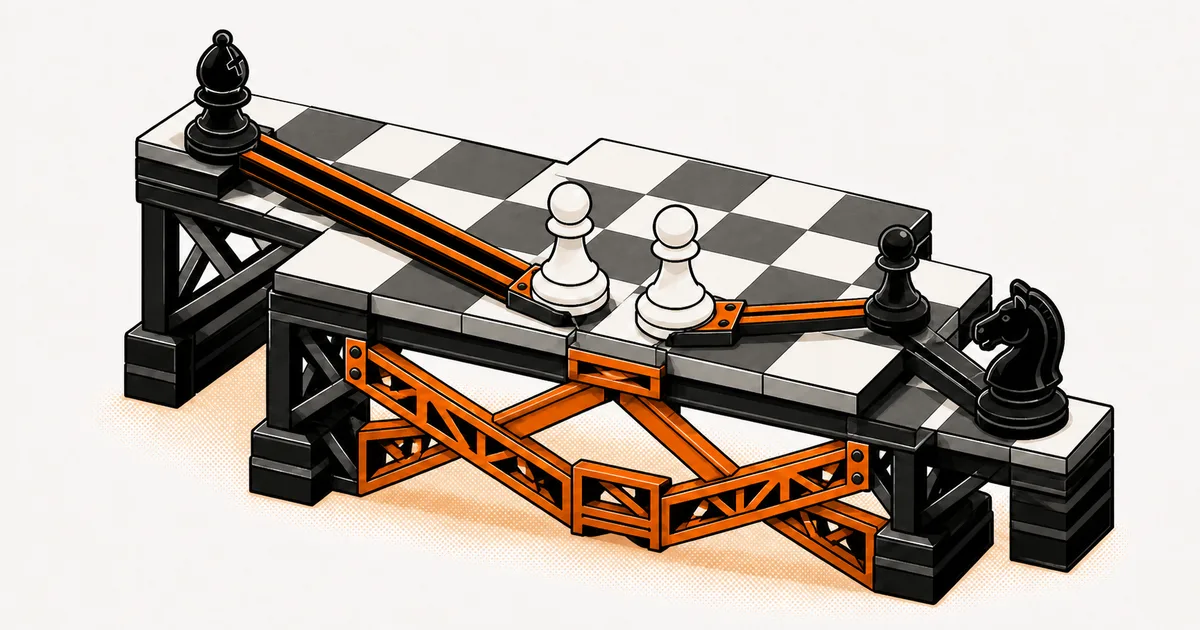
The Grunfeld Defense, also written Grünfeld Defense, begins with `1.d4 Nf6 2.c4 g6 3.Nc3 d5`. Black allows White to occupy the center, then attacks that center with piece pressure and pawn breaks, especially against d4. White usually receives space and may build a broad pawn center; Black aims to make that center prove it can advance, stay defended and survive exchanges. For a club player, the practical task is not to memorize one enormous line. Learn what changes when the center is exchanged, reinforced or delayed, then attach each resulting structure to a separate repertoire branch.
What is the Grunfeld Defense?
The Grunfeld is a defense to 1.d4 built around an immediate ...d5 challenge. After 1.d4 Nf6 2.c4 g6 3.Nc3 d5, Black contests White’s central ambitions before completing the kingside fianchetto.
That timing defines the opening. Black does not claim that occupying the center is bad. Instead, Black asks whether White can maintain a central pawn mass while Black develops toward it. The bishop commonly reaches g7, the c-pawn may challenge d4 with ...c5, and pieces can add pressure to the same central squares.
White should not defend the center by reflex. Space is useful when it improves piece activity, supports a well-timed advance or creates a passed pawn after exchanges. If every piece becomes a bodyguard for d4 or e4, the center may restrict White instead of helping.
Read the center before choosing a line
The root move order creates tension between White’s c4-pawn and Black’s d5-pawn. White’s next choice changes the type of work both sides must do.
| Branch | White’s central decision | Black’s main question | Training focus |
|---|---|---|---|
| Exchange | Resolve with cxd5, then often build with e4 |
How should Black attack d4 and the pawn center? | Break timing and piece pressure |
| Russian | Develop with Nf3 and pressure d5 with Qb3 |
Can Black resolve the center without losing coordination? | Queen placement, development and central control |
| Neo-Grunfeld | Delay Nc3, often through 3.Nf3 |
How does the missing knight on c3 change exchanges and transpositions? | Move-order ownership and structure recognition |
These are families, not forced scripts. A move order can branch earlier, later or transpose. Use the actual pawn structure and piece placement to decide which plan applies.
Exchange Variation: White builds the center, Black attacks it
A defining Exchange structure begins 1.d4 Nf6 2.c4 g6 3.Nc3 d5 4.cxd5 Nxd5 5.e4 Nxc3 6.bxc3 Bg7. White has exchanged the c-pawn and built pawns on d4 and e4. Black has exchanged a knight on c3 and developed the bishop toward the center.
White’s center controls space and can support active piece play. The c3-pawn reinforces d4, while e4 may support an advance or help develop pieces behind the center. White often wants rapid development because the center is strongest when the pieces can use the lines it controls.
Black’s target is not simply one loose pawn. The strategic question is whether the d4–e4 formation can be challenged by ...c5, pressure from the g7-bishop and coordinated pieces. If Black opens lines before development is ready, White may use the extra space. If Black waits without creating pressure, White may consolidate.
Train the position at the first central break. Before recalling a move, state:
- which pawn supports d4;
- which black piece already attacks the center;
- what
...c5would exchange or open; - whether both kings and undeveloped pieces make the break timely.
The sequence above identifies a structure. It is not a forced continuation, an engine recommendation or a claim that either side is better.
Train the Grunfeld by pressure
- Connect every center to Black’s counterplay
- Separate Exchange, Russian and Neo-Grunfeld plans
- Recall function-change positions with SM2
Russian System: pressure d5 before committing e4
The Russian System is commonly associated with 1.d4 Nf6 2.c4 g6 3.Nc3 d5 4.Nf3 Bg7 5.Qb3. White develops a knight and uses the queen to add pressure to d5. One illustrative continuation is 5...dxc4 6.Qxc4 0-0 7.e4, after which White has built a center in a different way from the immediate Exchange Variation.
Qb3 is purposeful only when you understand its jobs. The queen pressures d5, may influence b7 and supports central occupation after Black resolves the tension. It is also an early queen move, so White must check whether Black can gain useful development by attacking it.
Black should avoid treating the queen’s presence as a reason to improvise. Resolve the center only when the resulting development and pressure make sense. The g7-bishop, castling and a later challenge to d4 remain connected parts of the plan.
For training, separate three decisions: whether Black maintains or resolves the d5 tension, where White’s queen belongs after exchanges, and when White’s e-pawn should occupy e4. The moves shown are an announced, non-forced example. Other move orders and sidelines require their own calculation.
Neo-Grunfeld: the missing knight changes the map
The Neo-Grunfeld commonly arises when White delays Nc3, for example 1.d4 Nf6 2.c4 g6 3.Nf3 d5. Black still challenges the center with ...d5, but the absence of a knight on c3 changes Black’s exchange options and White’s setup.
White may combine Nf3 with g3 and a fianchetto, exchange on d5, or later add Nc3 or another central move. Black must read the position rather than import an Exchange Variation plan mechanically. Without a knight on c3, ...Nxc3 is not the same structural tool, and White may reach positions through a different order.
This is also where repertoire ownership matters. A flexible sequence can begin through a Réti move order and later reach a Neo-Grunfeld structure. Once the central pawns and Black’s ...d5 challenge define the position, store the detailed continuation under one owner instead of duplicating it.
Train the first position where the delayed Nc3 changes a central exchange or development plan. The Neo-Grunfeld is a family of related structures, not one forced sequence.
Plans for Black
Challenge d4 with pieces and a pawn break
The g7-bishop places long-range pressure on the center. The move ...c5 can challenge d4, but it should open useful lines or force a meaningful central decision. Playing the thematic break without checking development can release White’s position.
Make exchanges serve a structural goal
An exchange on c3 may alter White’s pawn structure in some lines. An exchange on d4 may reduce White’s center in others. Ask what file, diagonal, target or passed pawn the exchange creates before making it.
Develop while attacking
Black’s concept works when new pieces join the pressure. Castling, developing the queenside and connecting rooks are not separate from the counterplay. Repeated attacks by one queen or bishop rarely replace coordination.
Reassess after every pawn advance
If White advances d5 or e5, old targets may disappear and new squares may weaken. Stop repeating the original plan. Identify the new base of the chain and the break that can reach it.
Plans for White
Turn space into active development
White should place pieces where the center gives them useful squares. Development matters more than preserving every pawn formation unchanged. If a central exchange opens a file or diagonal, use it quickly.
Decide whether to hold, advance or exchange
When Black plays ...c5, White may maintain tension, advance or exchange according to the actual position. No answer is universal. Count defenders, identify the resulting pawn structure and check which pieces benefit from opened lines.
Protect the center efficiently
A broad center needs support, but overprotection can make pieces passive. Ask which defender has another useful job and whether a tactical detail, rather than a strategic slogan, makes a pawn vulnerable.
Notice passed-pawn potential and weak squares
Central exchanges may create a passed pawn, but a passed pawn can also become a target. Advancing it is useful only when the pieces support the new square and the move does not surrender control elsewhere.
Grunfeld Defense versus King’s Indian Defense
Both defenses can begin 1.d4 Nf6 2.c4 g6 and often develop the bishop to g7. The key difference is the timing and form of the central challenge.
In the Grunfeld, Black plays an early ...d5, directly contesting White’s center. In many King’s Indian structures, Black uses ...d6, allows White to establish more central space and later attacks that center with breaks such as ...e5 or ...c5.
Choose by the positions you want to study. The Grunfeld emphasizes early central tension, exchanges and pressure on d4. The King’s Indian more often keeps a closed or locked center before later breaks. Move orders can transpose or diverge, so compare the board, not only the opening label.
The Grunfeld Two-Pass Pressure Drill
The Grunfeld Two-Pass Pressure Drill is a manual study method. ChessFlare does not automatically detect a move’s function or identify when the center changes. You make those annotations yourself.
Pass one: label the function of each move
Take one short branch and give every move one primary label:
- occupy — a pawn takes central space, such as e4;
- challenge — a move attacks or undermines the center, such as a prepared
...c5; - exchange — a capture resolves central tension or changes the pawn structure;
- develop — a piece enters play while supporting the position;
- break — a pawn move aims to transform the chain or open lines.
Choose the label that best explains why the move belongs in your repertoire. If a move has two jobs, write the secondary job in a short note rather than inventing another category.
Pass two: revisit only function-change positions
Start again, but do not review every move equally. Stop only where the center’s function changes. Examples include:
- White changes from occupying the center to advancing it;
- Black changes from developing pressure to executing a pawn break;
- an exchange removes the pawn from d4 or creates a new pawn on c3;
- a previously supporting pawn becomes a passed pawn;
- a transposition changes which branch should own the position.
At each stop, answer four questions: What changed? Which pawn is now the target or lever? Which piece gained or lost a useful line? What plan replaces the previous one?
This second pass keeps attention on decisions rather than move count. A ten-move branch may contain only two positions worth repeated structural review.
Worked, non-forced example
Use the illustrative Exchange sequence 1.d4 Nf6 2.c4 g6 3.Nc3 d5 4.cxd5 Nxd5 5.e4 Nxc3 6.bxc3 Bg7. On pass one, 3...d5 is challenge, 4.cxd5 is exchange, 5.e4 is occupy, 5...Nxc3 is exchange, and 6...Bg7 is develop with pressure.
On pass two, revisit 4.cxd5 because tension changes, 5.e4 because White creates the broad center, and 6.bxc3 because the pawn structure changes and d4 gains a new supporter. Do not infer that the example is forced or best. Its job is to demonstrate the annotation method.
Common Grunfeld mistakes
Memorizing tactics without the pawn structure
Sharp sequences are easier to forget when you cannot explain the target. Before studying a continuation, name the center, the intended break and the piece that benefits.
Playing ...c5 because it is thematic
A thematic move can be mistimed. Check whether Black’s pieces support the break and whether opening the center helps White’s development.
Treating White’s center as automatically weak
A broad center can give White space, activity and passed-pawn chances. Black must create concrete pressure; the opening name does not supply it.
Defending every central pawn
White can lose time by making every piece protect d4 or e4. Some positions call for an advance, an exchange or active counterplay instead.
Mixing Exchange, Russian and Neo-Grunfeld plans
The branches share ideas but differ in queen placement, pawn structure and the knight’s location. Organize them separately and mark the first position where their plans diverge.
Following an example after the position changes
Every sequence in this guide is explicitly non-forced. If your opponent changes the center, stop recalling the sample and calculate the position you have.
Who should play the Grunfeld Defense?
The Grunfeld can suit players who enjoy active piece play, early central tension and positions where one pawn exchange changes several lines. It rewards learning plans and calculating concrete breaks.
It may be a poor fit if you want a fixed setup regardless of White’s choices or dislike defending positions where White has more central space. The Russian and Exchange families can become tactically demanding, while quieter sidelines still require structural judgment.
Sample one position from each featured family before building a large repertoire. Prefer the branch whose decisions you can explain, not the one with the longest move list.
Build a practical Grunfeld repertoire
Start by creating or importing a repertoire with 1.d4 Nf6 2.c4 g6 3.Nc3 d5 as the main root. Organize separate branches for Exchange, Russian and deviations. Keep Neo-Grunfeld positions under their own move-order branch because White has delayed Nc3.
Use a chess opening tree to see where the shared moves separate. For each branch, store one explanation of the center, one intended break and one warning that makes the plan invalid. If you also play a Queen’s Gambit, compare positions by pawn structure so similar d-pawn decisions do not become duplicate notes.
Then run the Two-Pass Pressure Drill. Practice each function-change position with Opening Trainer: recall the move, but also say whether its job is occupy, challenge, exchange, develop or break. Active recall is most useful when it retrieves a reason as well as a sequence.
Return to difficult branches through spaced review and SM2. Review scheduling does not evaluate the position or choose a move; it schedules another recall attempt. Update the branch annotation whenever a central exchange changes the plan.
ChessFlare can be used to create or import the repertoire, organize branches, practice active recall and schedule review with SM2. The Two-Pass labels, function-change detection and chess judgment remain manual.
Honest limits of this guide
This guide does not provide engine evaluations, best-move claims, win rates, popularity data or an exhaustive theory tree. It focuses on defining move orders, recurring plans and a manual training method.
The examples are non-forced structure markers. Tactics can override every general plan, and each featured family contains sidelines not covered here. Use the guide to organize questions; use the actual position to calculate answers.
Grunfeld Defense FAQ
Short answers about the Grunfeld move order, Exchange, Russian and Neo-Grunfeld structures, central counterplay and practical training.
What is the Grunfeld Defense?
The Grunfeld Defense begins with 1.d4 Nf6 2.c4 g6 3.Nc3 d5. Black immediately challenges White’s central ambitions with ...d5 and later piece pressure and pawn breaks.
What is Black’s main plan in the Grunfeld Defense?
Black commonly develops the bishop to g7, pressures d4 and prepares a central challenge such as ...c5. The timing depends on development, tactics and the resulting pawn structure.
What is the Grunfeld Exchange Variation?
A defining move order is 1.d4 Nf6 2.c4 g6 3.Nc3 d5 4.cxd5 Nxd5 5.e4 Nxc3 6.bxc3, where White builds a broad center and Black aims to attack it.
What is the Russian System against the Grunfeld?
The Russian System commonly uses Nf3 and Qb3 to develop while adding pressure to d5. White may occupy e4 after Black resolves the central tension.
How is the Grunfeld different from the King’s Indian Defense?
The Grunfeld uses an early ...d5 to challenge White’s center directly. Many King’s Indian structures use ...d6 first and attack the established center later with ...e5 or ...c5.
Does ChessFlare automatically detect Grunfeld pressure changes?
No. The Grunfeld Two-Pass Pressure Drill is a manual editorial method. ChessFlare can organize repertoire branches, support active recall and schedule SM2 review, but no automatic function detection is claimed.