

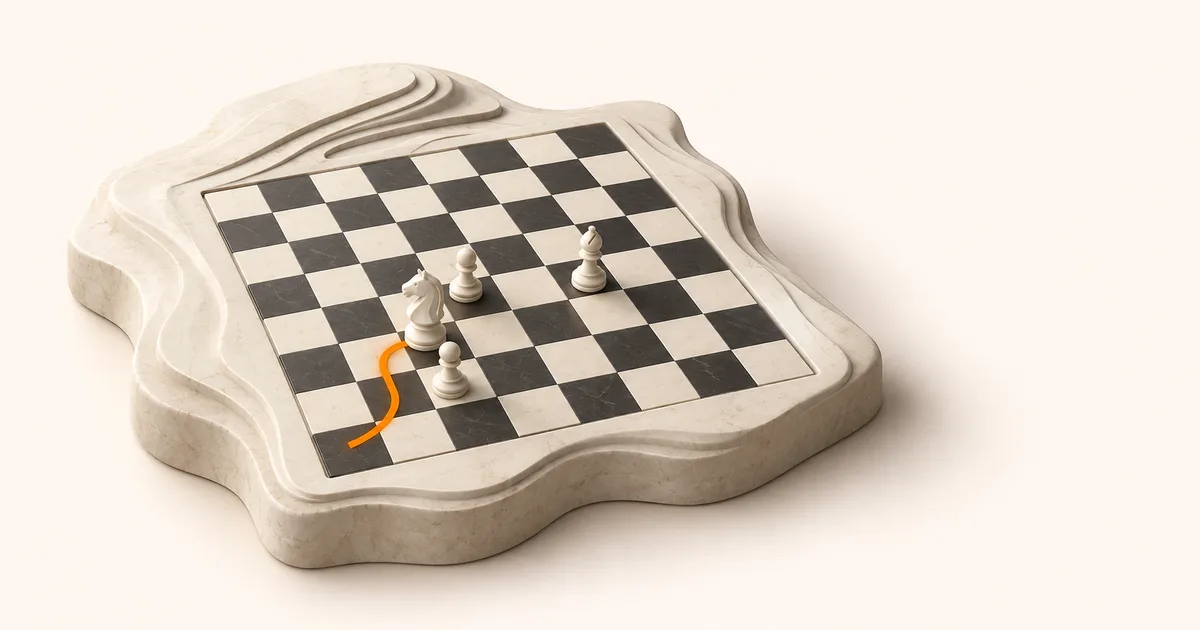
The Jobava London System is defined here by 1.d4 Nf6 2.Nc3 d5 3.Bf4. White develops the queen’s knight before the c-pawn, gaining immediate influence over e4 and d5 but giving up the usual c3 or c4 pawn option until that knight moves.
Imagine reaching this root and seeing Black challenge d4 with ...c5. A memorized classical-London response built on c3 is unavailable because the knight already occupies that square. That commitment makes the opening distinct: read Black’s first challenge, choose a center plan that respects the blocked c-pawn, check forcing moves, and split the repertoire only when the position demands a different decision.
What defines the Rapport-Jobava System?
Use this exact position as the reference root:
1.d4 Nf6 2.Nc3 d5 3.Bf4
White has placed a pawn on d4, developed the queen’s knight to c3, and developed the dark-squared bishop to f4. Black has developed the king’s knight to f6 and placed a pawn on d5.
The early Nc3 is the defining practical commitment. It adds control of e4 and d5, but the knight now stands directly in front of White’s c-pawn. That changes how White can reinforce, challenge, or transform the center.
“System” does not mean “ignore the opponent.” It means the opening begins from a recognizable set of commitments. Black’s next move can attack d4, reinforce d5, develop toward a fianchetto, activate a bishop, or avoid the expected structure. Each choice asks White a different question.
Jobava London versus the classical London
The Jobava and classical London share d4 and an early Bf4, but they should not be stored as one interchangeable branch.
| Decision | Jobava London | Classical London tendency |
|---|---|---|
| Queen’s knight | Commits early to c3 | Usually keeps c3 free, often developing to d2 |
| c-pawn | Cannot move while the knight remains on c3 | Frequently retains access to c3 or c4 |
| Central influence | Knight immediately supports e4 and contests d5 | Pawn structure can support the center differently |
| Repertoire logic | Organize by Black’s challenge to the committed setup | Organize around a more flexible London structure |
| Main risk | Copying a London plan that requires the c-pawn | Playing a familiar setup without reading Black’s structure |
The comparison is structural, not evaluative. Neither setup is declared better here. Choose according to the decisions you want to practise.
If you want the more flexible setup in which the queen’s knight does not immediately block the c-pawn, use the classical London System guide. Keep the two roots separate even when later piece placements look similar.
Train the Jobava as decisions
- Separate each central challenge
- Remember the cost of early Nc3
- Review fragile branches with active recall
What White commits with 2.Nc3
Early Nc3 gives White something useful immediately: a developed piece that influences e4 and d5. It also creates three obligations.
First, White must account for the c-pawn. Plans that depend on an easy c3 reinforcement or a direct c4 challenge are unavailable while the knight remains on c3.
Second, White must decide what the knight is doing beyond occupying a thematic square. Is it supporting an e-pawn advance, helping control d5, joining a tactical idea, or preparing to relocate later? A developed piece without a role can become an obstacle.
Third, White must compare central ambition with development and king safety. Control of e4 does not make an e-pawn advance automatically sound. Before opening the center, check which pieces are ready, which king becomes exposed, and what Black can force in reply.
Think of Nc3 as a trade-off, not a slogan: immediate piece activity in exchange for reduced c-pawn flexibility.
Build branches from Black’s first challenge
Do not begin with variation names or deep sequences. Begin with the first Black move that changes White’s central or developmental task.
Black challenges d4 with ...c5
After the reference root, ...c5 is a direct c-pawn challenge to White’s d4-pawn. Record it as a dedicated branch. White must decide whether to maintain tension, exchange, reinforce the center, or prepare expansion through another pawn.
The blocked c-pawn matters immediately. A response borrowed from a classical London may depend on c3 or c4, neither of which is currently available. Before choosing a move, inspect the pressure on d4, the safety of an e-pawn advance, and whether the c3-knight is helping or obstructing the intended structure.
Black reinforces the d5 center
Black may support d5 with another pawn and build a compact center. White should not interpret that setup as permission to launch an automatic kingside attack.
Ask which pawn break could challenge the structure, what preparation that break requires, and which pieces would gain or lose squares after it. If the intended plan needs the c-pawn, either define a safe knight relocation or choose a plan that works with the knight still on c3.
Black prepares a kingside fianchetto
A kingside fianchetto changes the long-range pressure on the center. White should record when Black’s bishop becomes relevant to d4 and the central dark squares rather than treating the setup as a cosmetic difference.
Decide how much central space White can support, whether an e-pawn advance opens useful lines or creates targets, and how both sides will complete development. The branch belongs in the repertoire because the source of Black’s pressure has changed.
Black develops a bishop actively
An early bishop move can challenge White’s bishop, pin a knight, or increase pressure on the center. Treat the concrete task as the branch label: bishop exchange, pin, or central pressure.
Do not save a branch merely because a bishop reached a familiar square. Save it when the move changes White’s development order, central choice, or tactical safety.
Black avoids the reference position
If Black changes the move order before 1.d4 Nf6 2.Nc3 d5 3.Bf4 is reached, do not pretend the reference position occurred. Create a separate root or connect a genuine transposition only after the same board position is reached with the same side to move and the same relevant rights.
A repertoire tree should describe positions, not force every game under one opening label. The chess opening tree guide explains why branch ownership and transpositions matter when a repertoire grows.
The Nc3 Commitment Map
The Nc3 Commitment Map is a manual editorial method for studying this opening. It is not an engine score, a forced-line generator, or an automatic ChessFlare feature.
Use six checks at every critical position:
| Check | Question | What to record |
|---|---|---|
| Position | Has the exact reference position been reached? | Move order, side to move, and any deviation |
| Commitment | What does Nc3 enable and prevent here? | e4/d5 influence, c-pawn status, and knight role |
| Challenge | What is Black asking White to solve? | d4 pressure, d5 support, fianchetto, bishop activity, or another concrete task |
| Center | Which pawn decision fits the current pieces? | Maintain, exchange, reinforce, expand, or postpone |
| Tactics | What are the forcing moves? | Checks, captures, threats, loose pieces, and king exposure |
| Exit | When does this branch stop being the same problem? | New structure, knight relocation, transposition, or resolved tension |
Do not total the checks into a fake evaluation. Finish with one sentence:
Because Nc3 gives ___ but prevents ___, Black’s challenge is ___, so this branch trains ___.
If you cannot complete that sentence, the branch is not ready for memorization.
Concrete checkpoint
At 1.d4 Nf6 2.Nc3 d5 3.Bf4, Black is to move. White’s c-pawn cannot advance because the c3-knight blocks it. White’s knight controls e4 and attacks d5; the d4-pawn controls c5 and e5, while Black’s f6-knight defends the pawn on d5.
Before adding any continuation, answer:
- What does Black’s next move attack, defend, or prepare?
- Does White’s intended response require the blocked c-pawn?
- If White advances the e-pawn later, which pieces and king are ready for the center to open?
- What forcing reply must be checked first?
- At what move would this become a genuinely different branch?
This is a safe training checkpoint because it describes the verified position and the required decisions without inventing a universal best continuation.
Minimum viable repertoire tree
Start shallow:
- Root:
1.d4 Nf6 2.Nc3 d5 3.Bf4. - Branch 1: Black directly challenges d4.
- Branch 2: Black reinforces the d5 center.
- Branch 3: Black prepares a kingside fianchetto.
- Branch 4: Black develops a bishop with a concrete task.
- Branch 5: Black avoids the reference position or reaches another structure.
- Transpositions: connect only positions that are actually identical.
For every branch, save one checked continuation, one plan sentence, one tactical warning, and one exit condition. Add depth when your games or analysis expose a real decision. The guide on creating a chess opening repertoire provides a broader workflow for keeping this tree maintainable.
Common Jobava repertoire mistakes
Treating it as classical London autopilot
A plan that relies on c3 cannot be copied while a knight occupies that square. Recalculate from the board.
Assuming Nc3 guarantees an e4 advance
The knight supports e4, but support alone does not settle timing, king safety, or Black’s reply. Check the position before changing the center.
Attacking before Black creates a target
Kingside pieces may look active without having useful access. Identify a target, route, supporting pieces, and strongest defensive reply before saving an attacking line.
Moving the c3-knight only to release the pawn
A knight relocation costs time. Move it because the destination improves the position and the released c-pawn has a concrete job.
Mixing deviations into the reference branch
Similar piece placement does not prove a transposition. Preserve separate branches until the complete position matches.
Building theory deeper than understanding
A long move list cannot repair a missing answer to Black’s first challenge. Train the decision at the branch root before extending it.
Who should choose the Jobava London?
The Jobava London may suit a player who wants an early, visible commitment and is comfortable making central decisions without relying on the classical London c-pawn structure. It rewards players willing to check tactical details and organize their repertoire by the opponent’s response.
It may be a poor fit if you want maximum c-pawn flexibility, a single setup against every defense, or a quiet system that avoids concrete calculation. In that case, compare the Jobava with the classical London before choosing a repertoire root.
The opening name does not remove the need to calculate. Suitability depends on whether you want to practise the positions created by early Nc3, not on a promised result.
Train the Jobava London in ChessFlare
Turn the opening into a repeatable study loop:
- Create or import the reference root and keep it separate from your classical London repertoire.
- Add one branch for each meaningful Black challenge.
- Annotate every branch with the six Nc3 Commitment Map checks.
- Use Opening Trainer to practise recalling the move and plan from the position.
- When a branch fails recall, correct its explanation before adding more depth.
- Revisit fragile branches through spaced review.
ChessFlare can be used to create or import repertoire material, organize variations as branches, practise moves through active recall, and schedule later review. It does not automatically apply the Nc3 Commitment Map or choose a continuation for you.
A small tree with clear branch ownership is more useful than a large tree filled with speculative moves.
Honest limits
This guide verifies only the reference position 1.d4 Nf6 2.Nc3 d5 3.Bf4. It does not provide engine evaluations, win rates, popularity figures, historical claims, universal best moves, or playing-level recommendations.
The Black challenge categories are repertoire containers, not complete theory. Exact continuations must be checked before they are stored as move sequences. The Nc3 Commitment Map is qualitative and cannot replace analysis of the concrete position.
For an earlier bishop decision against the f6-knight while keeping the c-pawn free, compare the Trompowsky Attack.
Jobava London System FAQ
Short answers about the defining move order, the early Nc3 commitment, Black’s challenges, and repertoire training.
What is the Jobava London System?
This guide defines it through 1.d4 Nf6 2.Nc3 d5 3.Bf4. White combines d4 and Bf4 with an early Nc3, creating a different development commitment from a classical London setup.
How is the Jobava London different from the classical London?
The early knight on c3 is the key difference. It influences e4 and d5 immediately, but it also prevents the c-pawn from advancing while the knight remains there. Classical London move orders usually preserve that c-pawn choice longer.
Is the c-pawn permanently blocked in the Jobava London?
No. It is blocked while the knight occupies c3. A later knight move can release it, but that costs time and must fit the concrete position rather than being treated as an automatic repair.
Which Black challenges should a Jobava repertoire cover?
Start with distinct branches for direct pressure on d4, reinforcement of d5, kingside fianchetto development, active bishop development, and move orders that avoid the reference position.
What is the Nc3 Commitment Map?
It is a manual editorial study method that records the position, Nc3 trade-off, Black’s challenge, White’s central decision, tactical safety check, and branch exit. It is not an engine evaluation or an automatic ChessFlare feature.
How can I train the Jobava London System?
Create or import a shallow repertoire, divide it by Black’s first meaningful challenge, annotate each branch with the Nc3 Commitment Map, practise the decisions through active recall, and revisit fragile branches with spaced review.