

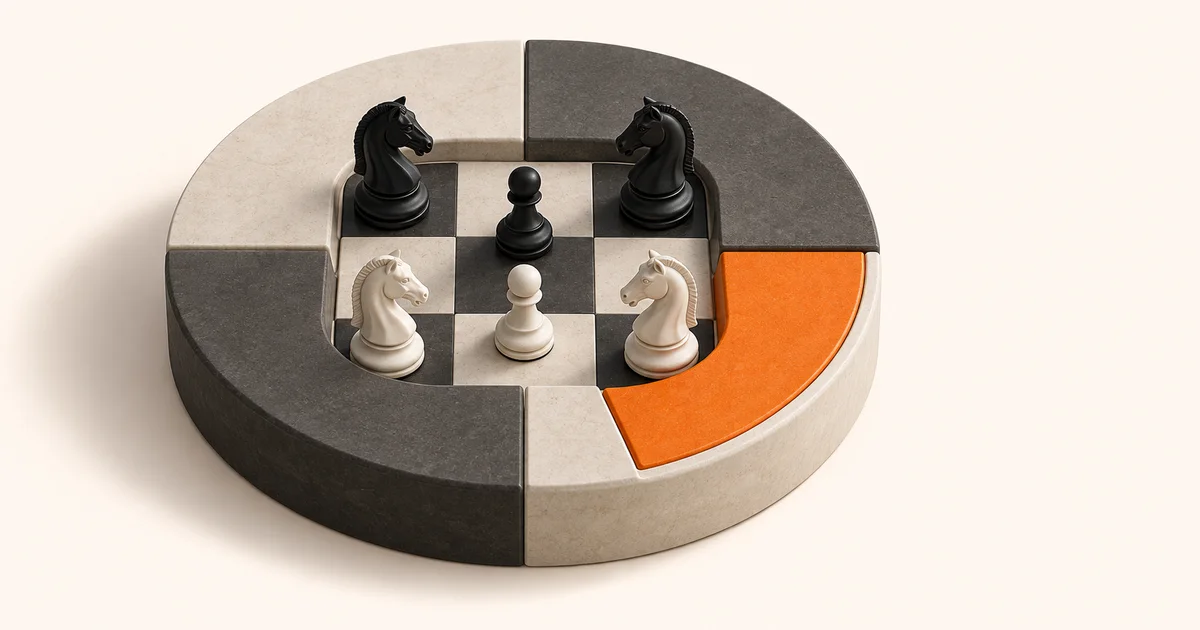
The Four Knights Game reaches 1.e4 e5 2.Nf3 Nc6 3.Nc3 Nf6. White's fourth move defines the next practical job: pressure c6, challenge e5, develop toward f7, or prepare Bg2.
The Four Knights Game reaches 1.e4 e5 2.Nf3 Nc6 3.Nc3 Nf6. Both sides have developed their knights, White has the move, and the central pawns remain on e4 and e5. White's fourth move now gives the position its practical direction.
This guide compares four choices rather than declaring a universal best move. 4.Bb5 pressures the c6 knight, 4.d4 challenges the center, 4.Bc4 develops toward f7, and 4.g3 prepares Bg2. Choose the job you want the move to perform, record what Black can change next, and train one branch you can explain.
Quick answer: what should White play on move four?
Start by choosing the kind of position you want to prepare:
| Choice covered here | Immediate job | First repertoire question |
|---|---|---|
4.Bb5 |
Develop and pressure the c6 knight | What will the bishop do if Black attacks it? |
4.d4 |
Challenge e5 and change the center | What follows if the center opens or the tension remains? |
4.Bc4 |
Develop toward f7 | How will White support the center and finish development? |
4.g3 |
Prepare Bg2 |
How will the f3 knight and e4 pawn affect the bishop? |
These are plan labels, not evaluations. Each move changes White's development order and the questions Black can ask.
Read the shared Four Knights position first
After 1.e4 e5 2.Nf3 Nc6 3.Nc3 Nf6, White's knights occupy f3 and c3, while Black's occupy f6 and c6. Black's f6 knight attacks e4; the c6 knight supports e5. White's c3 knight supports e4 and blocks the c-pawn. Both light-squared bishops remain undeveloped, and White's d-pawn has not committed.
This shared position explains why move four matters. White can pressure an e5 defender, challenge e5 directly, develop a bishop toward the kingside, or prepare a fianchetto. The useful question is not which label sounds familiar, but which board task fits the position you want to train.
4.Bb5: pressure the c6 defender
After 4.Bb5, White develops the f1 bishop and attacks the knight on c6. That knight helps defend e5, so the bishop move connects development with central pressure.
Do not call this a pin. The d7-pawn still stands between the c6 knight and the king on e8. Instead, decide whether White intends to exchange on c6 or preserve the bishop, how e4 will be maintained or transformed, and which d-pawn move supports the plan.
The bishop placement resembles the theme in the Ruy Lopez Opening, but the full position differs because all four knights are already developed. Use that page to understand the neighboring family, not to copy a Ruy Lopez line into this tree.
4.d4: challenge the center now
The move 4.d4 attacks the e5 pawn and opens the diagonal for White's c1 bishop. It gives the fourth move a central job before White develops the f1 bishop.
This route belongs to a Scotch branch of the Four Knights Game, but the exact position remains the source of truth. The standard Scotch Game reaches its central challenge earlier; here all four knights are already developed.
Record which central pawn is exchanged, whether the tension remains, what must recapture, and which files or diagonals open. The word Scotch files the branch; it does not answer Black's concrete reply.
4.Bc4: develop toward f7
With 4.Bc4, White develops the bishop toward f7 while keeping the d-pawn flexible. The c3 knight changes which supporting setups remain available: White cannot play the c-pawn to c3 while the knight occupies that square.
Do not copy an Italian Game plan built around c3 without checking the board. For this branch, record how White supports e4, whether the d-pawn belongs on d3 or advances later, how castling fits into White's development plan, and what Black's next central challenge changes.
The bishop's direction is a development fact, not proof of an attack. White still needs coordinated pieces and a response to pressure on the center.
4.g3: prepare the bishop on g2
The move 4.g3 prepares Bg2. After the bishop reaches g2, White's knight on f3 initially blocks the long diagonal. If that knight moves, the e4 pawn still limits the bishop until the center changes.
That makes this branch a coordination problem. Record where the f3 knight may move, how e4 will be maintained or transformed, where the d-pawn belongs, and what White will do if Black changes the center before the fianchetto is complete. The move is a development choice, not a complete plan by itself.
Train one clear Four Knights choice
- Compare four plans from one root
- Keep neighboring openings organized
- Review the first real decision
The Move-Four Identity Check
The Move-Four Identity Check is a manual editorial matrix for comparing the four choices in this guide. It is not an engine score or an automatic ChessFlare feature.
| Candidate | Immediate commitment | Board fact to verify | Branch task to train |
|---|---|---|---|
4.Bb5 |
Bishop commits to pressure c6 | How Black can attack, exchange, or release that bishop | Preserve or change the bishop's job |
4.d4 |
d-pawn changes the central tension | Captures, recaptures, and opened lines | Respond to the first concrete central change |
4.Bc4 |
Bishop develops toward f7 | e4 support and Black's central reply | Complete development without inventing an attack |
4.g3 |
g-pawn prepares Bg2 |
f3-knight route, e4 status, and diagonal access | Coordinate knight, bishop, and center |
Apply four steps:
- Reconstruct the root and confirm White is to move.
- Give the candidate one job using only visible board facts.
- Add a checked reply from your verified repertoire material when it attacks the moved piece, changes central pawn tension, or forces a recapture. That is a plan-changing reply.
- Train the fourth-move decision first; extend the line only when a real reply creates another decision.
Do not use this matrix to merge transpositions. The Vienna Game guide owns the detailed one-position-one-owner protocol for move-order overlaps. For a broader structure, see the chess opening tree guide.
Move-order links without duplicate branches
The same Four Knights position can arrive through the Vienna order 1.e4 e5 2.Nc3 Nc6 3.Nf3 Nf6 or the Petrov order 1.e4 e5 2.Nf3 Nf6 3.Nc3 Nc6. Both reach the shared position with White to move.
If a Vienna Game or Petrov Defense tree already stores that exact position, keep one full continuation and use a short pointer from the other route. Let the Vienna guide handle the full transposition-checking method; this page owns the comparison of White's fourth move from the shared root.
Build a compact Four Knights repertoire
A useful repertoire does not need every legal fourth move. It needs one deliberate choice and checked answers to replies that change its job.
- Create a Four Knights repertoire or import prepared PGN material.
- Store
1.e4 e5 2.Nf3 Nc6 3.Nc3 Nf6as the root. - Compare the four moves with the Move-Four Identity Check.
- Keep the move you intend to play as the trained branch.
- Organize verified Black replies beneath that choice.
- Train the choice with active recall.
- Keep fragile continuations in spaced review.
ChessFlare supports creating or importing repertoire material, organizing branches, active-recall training, and spaced review. Practice the chosen branch in the ChessFlare Opening Trainer. If your material is still scattered, first follow how to create a chess opening repertoire.
Common Four Knights study errors
Comparing forever without choosing
Keep alternatives as reference material, then train one fourth move from the shared root.
Copying a neighboring opening by name
A Four Knights branch may resemble Ruy Lopez, Scotch, or Italian themes without sharing every move and state detail. Compare the board before reusing material.
Treating 4.g3 as a complete plan
The move only prepares Bg2. Your branch must account for the f3 knight, e4 pawn, d-pawn, development, and Black's central action.
Treating bishop pressure as a tactic
4.Bb5 attacks c6 and 4.Bc4 points toward f7, but neither fact proves a combination. Record how the other pieces and central pawns support the idea.
Fit and honest limits
Use this guide when you recognize the Four Knights root and need to select or organize White's fourth move. It is not a complete opening encyclopedia and does not provide move-frequency statistics, history, engine evaluations, win rates, rating advice, a forced best move, or automatic transposition detection. Use a database or analysis tool for those jobs, then bring only selected, checked lines into the repertoire.
The Move-Four Identity Check is qualitative. It helps name the job of a move, but it cannot replace analysis of Black's concrete reply.
Four Knights Game FAQ
Direct answers about the shared position, four fourth-move choices, and practical repertoire training.
What is the Four Knights Game?
The Four Knights Game reaches 1.e4 e5 2.Nf3 Nc6 3.Nc3 Nf6, with all four knights developed and White to move.
Which fourth-move choices does this guide cover?
This guide compares 4.Bb5, 4.d4, 4.Bc4, and 4.g3: pressure on c6, a central challenge, development toward f7, or preparation for Bg2.
What is the difference between 4.Bb5 and 4.Bc4?
4.Bb5 attacks the c6 knight, while 4.Bc4 develops the bishop toward f7. They create different development plans and should remain separate repertoire branches.
Is 4.d4 the same as the Scotch Game?
It uses a Scotch-style central challenge, but this position already has all four knights developed. Keep the exact move order and board state as the source of truth.
What is the idea of 4.g3?
4.g3 prepares Bg2. After Bg2, the f3 knight initially blocks the long diagonal; if that knight moves, the e4 pawn still limits the bishop until the center changes.
How should I train the Four Knights Game?
Choose one fourth move, attach it to a clear job, add verified replies that change that plan, and practice the decision with active recall and spaced review.